A Nordic winter does not just test the insulation of an entry door — it tests its hardware and seals. At -20°C, a lock that turns smoothly in October can stiffen by January, a cheap rubber seal can shrink and crack, and a door closer that held its tension in summer may fail to pull the leaf shut. For distributors and contractors across Norway, Sweden, Finland and Denmark, specifying hardware and seals as carefully as the panel is what separates a door that performs from one that generates service calls every winter.
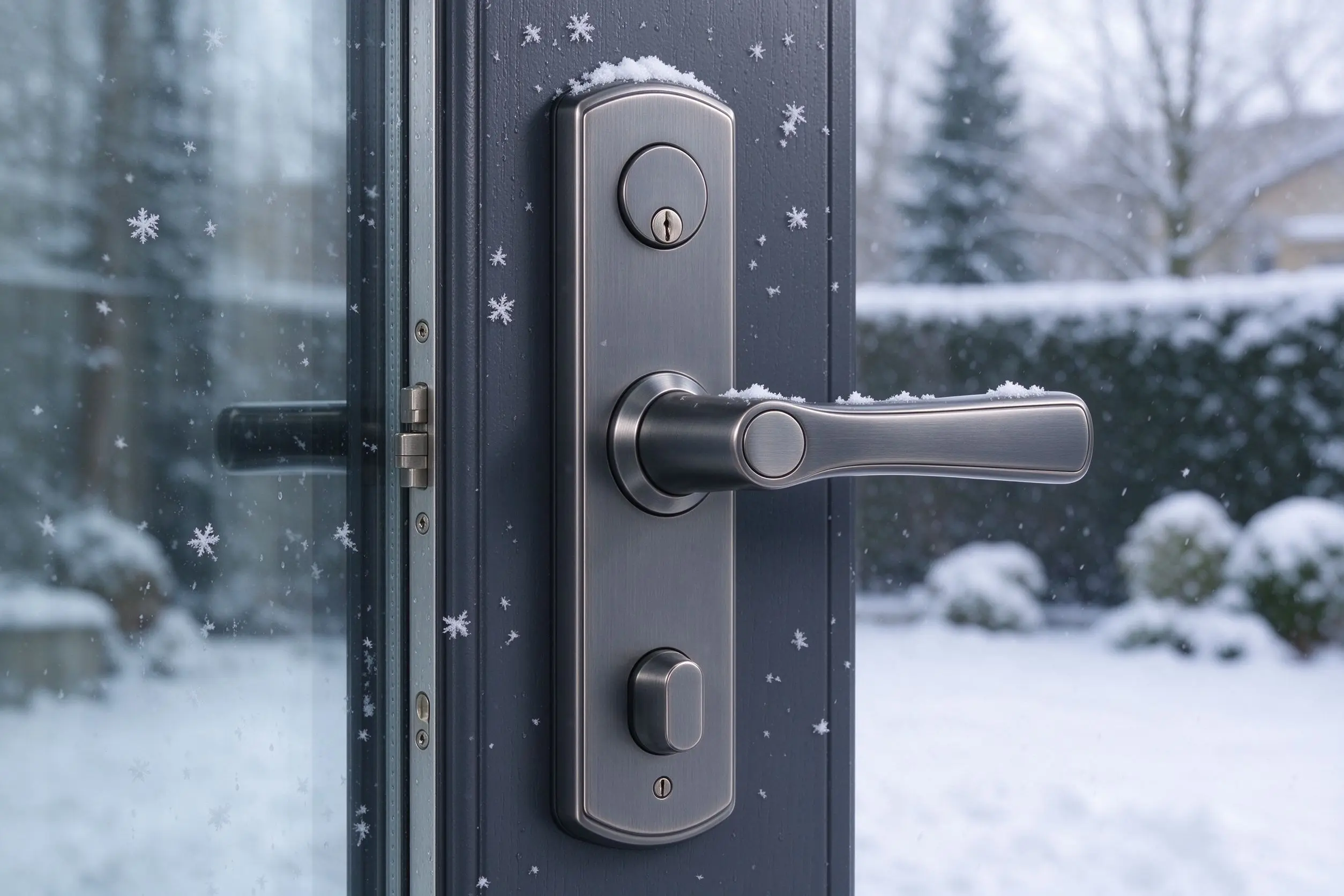
Multi-point locks: why the leaf needs more than a single deadbolt
A single lock at handle height leaves the top and bottom of the leaf free to lever open, and in a cold hall that gap is where draught, ice and dust collect. Nordic specifications therefore call for multi-point locking: three to five locking points — hooks or bolts — engaging the frame along the full height of the leaf. Beyond security, this compresses the perimeter seal evenly, which is what keeps cold air out and warm air in. Buyers should ask for the lock type (hook versus bolt), the number of points, and whether the backset and faceplate match the frame they are supplying.
Hardware rated for cold operation
Standard European hardware is tested at room temperature. Nordic procurement increasingly asks for components that have been cycle-tested at sub-zero temperatures: hinges that carry leaf weight without sagging after thousands of freeze-thaw cycles, lock cylinders that turn with low force at -20°C, door closers whose hydraulic fluid does not thicken. Established European brands dominate this segment, but factories that let buyers specify their own hardware brand — rather than shipping a generic lock — remove the winter-failure risk.
Seals and thresholds
Perimeter seals in EPDM, not PVC or cheap rubber, are the default in credible Nordic specifications. EPDM stays elastic across a far wider temperature band and resists UV and ozone. A drop seal at the bottom closes the gap between leaf and threshold when the door shuts; combined with a thermally broken aluminium threshold and drainage slots, it stops the morning ice build-up at the sill. Specifiers should also confirm whether seals are required where the door sits on a route.
Winter maintenance advice to pass to clients
- Clean and lightly lubricate lock cylinders with graphite or PTFE spray — never oil, which collects grit
- Check and adjust multi-point lock keepers annually so the leaf still compresses the seal evenly
- Inspect EPDM seals for brittleness or compression set after the first winter; replace where cracked
- Verify the door closer still shuts and latches the leaf in January, not only in October
How Skylink equips Nordic orders
Skylink supplies insulated steel and aluminium entry doors with hardware specified by the buyer: multi-point locks, European brand hinges and closers, and EPDM perimeter seals as standard. Because around 80% of production is custom, the frame, backset and seal arrangement are engineered to each project's drawings rather than chosen from a fixed catalogue. Each order ships with CE/CPR documentation, and multilingual installation and maintenance guidance. Lead times start at 25 working days, MOQ from 10 sets.
Distributors in the Nordics can request a hardware schedule and seal specification sheet by contacting the Skylink export team.